# Chapter 1: Monster Lore

URL:: https://dndbeyond.com/sources/vgtm/monster-lore
Author:: Monster Lore
## Highlights
> Some of the behaviors and motivations that beholders exhibit are analogous to those of humans and other intelligent creatures. The difference is one of degree. For instance, where a prideful, confident human might be cowed by a serious threat, the arrogance of a beholder knows no such bounds: it believes that it is superior to every other creature, even including other beholders. A human chess player becomes a master by honing the ability to look several moves ahead during a game — which is still no match for what a beholder can accomplish with its superior intelligence and awareness. ([View Highlight](https://read.readwise.io/read/01fexmg6w9888mtvn87p5f132w))
> The mind of a beholder is powerful and versatile enough that it can envision literally any possibility, and it prepares accordingly, making it virtually impossible for any invaders to catch it unawares. This way of thinking could be interpreted as a form of paranoia — and if so, it would be the most extreme form imaginable. While a human tyrant might be rightfully paranoid about unperceived threats, a beholder is paranoid even though it perceives everything, because that attitude is the natural companion to eternal vigilance. ([View Highlight](https://read.readwise.io/read/01fexmgf3z4wh20kqyw0w0fpjm))
> Beholders are among the few creatures that can shape reality in their vicinity. In addition, beholders don’t truly sleep when they rest. Instead, a beholder’s mind remains semiconscious even as it dreams. As a result, on rare occasions when a beholder dreams of another beholder, the dream-reality becomes warped and takes on physical form, becoming another actual beholder. To call this process reproduction would be inaccurate, because in most cases the old and new beholders fight to the death — a fact for which the rest of the world is thankful. ([View Highlight](https://read.readwise.io/read/01fexmgrb68z1yxmpn3tk1mw18))
> Most of a beholder’s mental activity is devoted to unearthing plots against itself (real or imaginary), planning attacks against known rivals, and preparing its defenses against all possible threats. ([View Highlight](https://read.readwise.io/read/01fexmj21yhnt2tmn80xy21p2m))
> An eye tyrant is a solitary beholder that has suppressed its xenophobia and paranoia and chooses to live as the leader or ruler of a community or an organization that includes other creatures. ([View Highlight](https://read.readwise.io/read/01fexmkt2yrv4kyzt0xsj3yrj2))
> When the dreamer awakens, it treats the newborns as extensions of its own self in other bodies, and therefore isn’t consumed with an urge to kill them. This united group of identical beholders doesn’t truly have a hive intelligence, but their personalities and goals are so similar that they can predict and assume each others’ behavior, much as especially close human siblings can. The original beholder is usually the dominant one and takes a leadership role. A hive consists of three to ten beholders, plus whatever minions they control. ([View Highlight](https://read.readwise.io/read/01fexmmmhawvw68614gxas9gac))
> As a beholder ages, it spends more and more time worrying about its mortality. The dreams of such a death-fearing beholder might reach into strange corners of reality and imagine circumstances in which the creature can live on after death. When the beholder awakens, it finds itself transformed into a death tyrant. It now exists in a state of undeath — yet its fear of being killed remains unabated. ([View Highlight](https://read.readwise.io/read/01fexmnqenwpqtx4c67xtpgsk3))
> The lesser creatures known as beholder-kin bear a superficial resemblance to true beholders in that each has a floating spherical body with eyes. That’s where the similarity ends. ([View Highlight](https://read.readwise.io/read/01fexmpg3zts6ap1t1j3rfsz2d))
> A beholder analyzes its opponents, makes note of armor, weapons, and tactics, and adjusts its strategy to eliminate the most dangerous threats as quickly as possible. Although a beholder’s specific actions will vary with each encounter, the creature’s behavior is largely governed by the tactics discussed below. ([View Highlight](https://read.readwise.io/read/01fexmx64ejgq1mwbhzqrgtpj0))
> [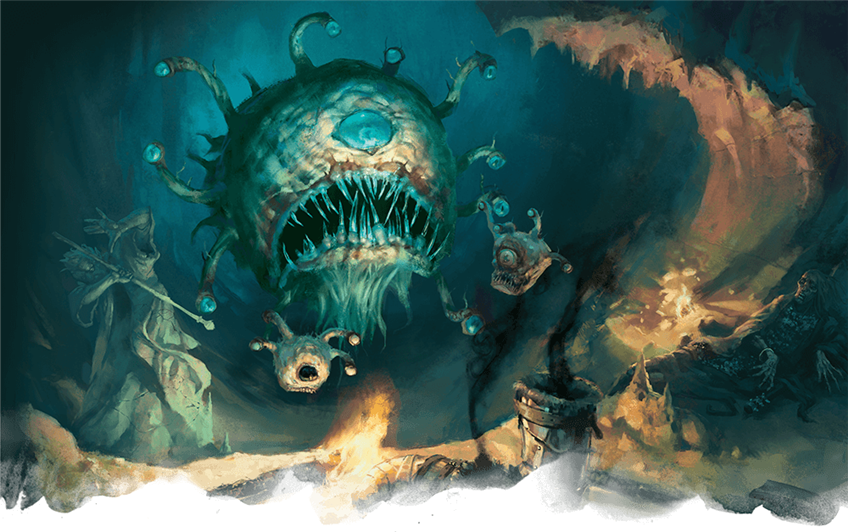](https://www.dndbeyond.com/attachments/1/653/volo01-02.png) ([View Highlight](https://read.readwise.io/read/01fexmx79pfqqaga30bevw8x6h))
> Stay out of Range and Sight ([View Highlight](https://read.readwise.io/read/01fexmx8g92t0h00g9kd4r69ms))
> Use Antimagic Freely ([View Highlight](https://read.readwise.io/read/01fexmxwqfmdb5fm86b4cdvrjf))
> Because the cone suppresses ongoing magical effects, the beholder might create a secure area in its lair behind a permanent [wall of fire](https://www.dndbeyond.com/spells/wall-of-fire) or [wall of force](https://www.dndbeyond.com/spells/wall-of-force), make use of an existing magical hazard (such as a pool that transforms any creature that touches it), or an area with magical guardians (such as an old shrine with a demon bound to it) that it can bypass. ([View Highlight](https://read.readwise.io/read/01fexmyrss8vx5wfnvav3fzx8s))
> Use Traps and Minions ([View Highlight](https://read.readwise.io/read/01fexmz5aa97pe31nhnrn6vthe))
> Although each use of the charm effect lasts only an hour, repeated uses over time against the same target tend to wear down a creature’s will, creating a docile servant. ([View Highlight](https://read.readwise.io/read/01fexn0x8j2px4nt301hmcy02d))
> When a beholder’s dream-imagination runs wild, the result can be an offspring that has an unusual or unique set of abilities. Rather than the standard powers of a beholder’s central eye and eyestalks, the creature has one or more variant abilities — guaranteed to surprise any enemies who thought they knew what they were getting themselves into. ([View Highlight](https://read.readwise.io/read/01fexn1y073r7ae4v654zykw4f))
> Enervation Ray: [create undead](https://www.dndbeyond.com/spells/create-undead) (usable regardless of the time of day), [polymorph](https://www.dndbeyond.com/spells/polymorph) (1 minute) ([View Highlight](https://read.readwise.io/read/01fexn2gzyabwrc9430k2qrs6j))
> Because a beholder’s paranoia knows no limits, it often designs its lair to include secret passageways that are used for reconnaissance or surprise attacks. (These features aren’t shown on the accompanying map, but can be located anywhere you see fit.) A typical arrangement is a network of tunnels running above the main chambers of the lair, each wide enough for the beholder to fly through. Fist-sized holes in the floors of these tunnels open into the rooms below, allowing the beholder to spy on creatures in its lair and perhaps target them with eye rays. (Opponents can shoot back, but the holes function like arrow slits and provide three-quarters cover to the beholder.) ([View Highlight](https://read.readwise.io/read/01fexn46qez0mpjmh6khp3q11d))
> A beholder goes to a lot of trouble to make its lair as safe and comfortable as it possibly can, and so it rarely ventures outside. A typical beholder would primarily be concerned with securing the area in a 1-mile radius around its lair (corresponding to the area of the beholder’s regional effects), but could range even farther if the need arises. It might leave home to confront or forestall the advance of creatures that it sees as threats, or to capture a new pack of minions, or to go after a particularly enticing trophy. ([View Highlight](https://read.readwise.io/read/01fexn50c6x0bqpkxm9ay2xmea))
> [](https://www.dndbeyond.com/attachments/1/654/volo01-03.png) ([View Highlight](https://read.readwise.io/read/01fexn5hn0eaeqfpnyqx4w1njx))
> The Xanathar Guild is a thieves’ and slavers’ guild operating underneath the city of Waterdeep in the Forgotten Realms setting. The guildmaster is a beholder — the latest in a series of such creatures. Like its predecessors, the beholder uses “the Xanathar” as a title rather than its personal name (which is Zushaxx). The guild has been in operation for nearly two hundred years, with a different beholder taking over every few decades. ([View Highlight](https://read.readwise.io/read/01fey754p9xkkzvs3d3neg0tr2))
> Like all beholders, the Xanathar craves information. It is aware of the great library at Candlekeep and the lore stored there, and one of its main objectives is to get an agent into the place that can start sending copies of that information back to the Xanathar for review. ([View Highlight](https://read.readwise.io/read/01fey768f203yzmb63p7gxjh65))
> Giants Are Huge. Most giants can easily peer in a second-floor window. The larger ones would have to stoop to get down to that level! ([View Highlight](https://read.readwise.io/read/01fey78s2nn9e5nzaxh73pqsnf))
> Giants Are Loud. The footsteps of giants in the distance are often initially mistaken for thunder, even on a clear day. ([View Highlight](https://read.readwise.io/read/01fey791rptyf2xtx4dynqgs59))
> In an age before human and elf, when all dragons were young, Annam the All-Father put the first giants upon the world. These giants were reflections of his divine offspring and also children of the world, birthed from the marrow of mountains, the hot blood of volcanoes, and the breath of hurricanes. ([View Highlight](https://read.readwise.io/read/01fey79ke0x9n9d2zyy9jeth5k))
> Annam conceived the giants to be masters of the world. He gave them great height so they would look down on all they ruled. He created a hierarchy for his children — the ordning — so that all would know their status with respect to one another, and would know who among them stood nearest the knee of the All-Father. ([View Highlight](https://read.readwise.io/read/01fey79wzghhd3n6ax79vtxk1q))
---
Title: Chapter 1: Monster Lore
Author: Monster Lore
Tags: readwise, articles
date: 2024-01-30
---
# Chapter 1: Monster Lore

URL:: https://dndbeyond.com/sources/vgtm/monster-lore
Author:: Monster Lore
## AI-Generated Summary
D&D Beyond - Dungeons & Dragons Fifth Edition Tools, Rules, Races, Classes, Items, Spells, Monsters, and More
## Highlights
> Some of the behaviors and motivations that beholders exhibit are analogous to those of humans and other intelligent creatures. The difference is one of degree. For instance, where a prideful, confident human might be cowed by a serious threat, the arrogance of a beholder knows no such bounds: it believes that it is superior to every other creature, even including other beholders. A human chess player becomes a master by honing the ability to look several moves ahead during a game — which is still no match for what a beholder can accomplish with its superior intelligence and awareness. ([View Highlight](https://read.readwise.io/read/01fexmg6w9888mtvn87p5f132w))
> The mind of a beholder is powerful and versatile enough that it can envision literally any possibility, and it prepares accordingly, making it virtually impossible for any invaders to catch it unawares. This way of thinking could be interpreted as a form of paranoia — and if so, it would be the most extreme form imaginable. While a human tyrant might be rightfully paranoid about unperceived threats, a beholder is paranoid even though it perceives everything, because that attitude is the natural companion to eternal vigilance. ([View Highlight](https://read.readwise.io/read/01fexmgf3z4wh20kqyw0w0fpjm))
> Beholders are among the few creatures that can shape reality in their vicinity. In addition, beholders don’t truly sleep when they rest. Instead, a beholder’s mind remains semiconscious even as it dreams. As a result, on rare occasions when a beholder dreams of another beholder, the dream-reality becomes warped and takes on physical form, becoming another actual beholder. To call this process reproduction would be inaccurate, because in most cases the old and new beholders fight to the death — a fact for which the rest of the world is thankful. ([View Highlight](https://read.readwise.io/read/01fexmgrb68z1yxmpn3tk1mw18))
> Most of a beholder’s mental activity is devoted to unearthing plots against itself (real or imaginary), planning attacks against known rivals, and preparing its defenses against all possible threats. ([View Highlight](https://read.readwise.io/read/01fexmj21yhnt2tmn80xy21p2m))
> An eye tyrant is a solitary beholder that has suppressed its xenophobia and paranoia and chooses to live as the leader or ruler of a community or an organization that includes other creatures. ([View Highlight](https://read.readwise.io/read/01fexmkt2yrv4kyzt0xsj3yrj2))
> When the dreamer awakens, it treats the newborns as extensions of its own self in other bodies, and therefore isn’t consumed with an urge to kill them. This united group of identical beholders doesn’t truly have a hive intelligence, but their personalities and goals are so similar that they can predict and assume each others’ behavior, much as especially close human siblings can. The original beholder is usually the dominant one and takes a leadership role. A hive consists of three to ten beholders, plus whatever minions they control. ([View Highlight](https://read.readwise.io/read/01fexmmmhawvw68614gxas9gac))
> As a beholder ages, it spends more and more time worrying about its mortality. The dreams of such a death-fearing beholder might reach into strange corners of reality and imagine circumstances in which the creature can live on after death. When the beholder awakens, it finds itself transformed into a death tyrant. It now exists in a state of undeath — yet its fear of being killed remains unabated. ([View Highlight](https://read.readwise.io/read/01fexmnqenwpqtx4c67xtpgsk3))
> The lesser creatures known as beholder-kin bear a superficial resemblance to true beholders in that each has a floating spherical body with eyes. That’s where the similarity ends. ([View Highlight](https://read.readwise.io/read/01fexmpg3zts6ap1t1j3rfsz2d))
> A beholder analyzes its opponents, makes note of armor, weapons, and tactics, and adjusts its strategy to eliminate the most dangerous threats as quickly as possible. Although a beholder’s specific actions will vary with each encounter, the creature’s behavior is largely governed by the tactics discussed below. ([View Highlight](https://read.readwise.io/read/01fexmx64ejgq1mwbhzqrgtpj0))
> [](https://www.dndbeyond.com/attachments/1/653/volo01-02.png) ([View Highlight](https://read.readwise.io/read/01fexmx79pfqqaga30bevw8x6h))
> Stay out of Range and Sight ([View Highlight](https://read.readwise.io/read/01fexmx8g92t0h00g9kd4r69ms))
> Use Antimagic Freely ([View Highlight](https://read.readwise.io/read/01fexmxwqfmdb5fm86b4cdvrjf))
> Because the cone suppresses ongoing magical effects, the beholder might create a secure area in its lair behind a permanent [wall of fire](https://www.dndbeyond.com/spells/wall-of-fire) or [wall of force](https://www.dndbeyond.com/spells/wall-of-force), make use of an existing magical hazard (such as a pool that transforms any creature that touches it), or an area with magical guardians (such as an old shrine with a demon bound to it) that it can bypass. ([View Highlight](https://read.readwise.io/read/01fexmyrss8vx5wfnvav3fzx8s))
> Use Traps and Minions ([View Highlight](https://read.readwise.io/read/01fexmz5aa97pe31nhnrn6vthe))
> Although each use of the charm effect lasts only an hour, repeated uses over time against the same target tend to wear down a creature’s will, creating a docile servant. ([View Highlight](https://read.readwise.io/read/01fexn0x8j2px4nt301hmcy02d))
> When a beholder’s dream-imagination runs wild, the result can be an offspring that has an unusual or unique set of abilities. Rather than the standard powers of a beholder’s central eye and eyestalks, the creature has one or more variant abilities — guaranteed to surprise any enemies who thought they knew what they were getting themselves into. ([View Highlight](https://read.readwise.io/read/01fexn1y073r7ae4v654zykw4f))
> Enervation Ray: [create undead](https://www.dndbeyond.com/spells/create-undead) (usable regardless of the time of day), [polymorph](https://www.dndbeyond.com/spells/polymorph) (1 minute) ([View Highlight](https://read.readwise.io/read/01fexn2gzyabwrc9430k2qrs6j))
> Because a beholder’s paranoia knows no limits, it often designs its lair to include secret passageways that are used for reconnaissance or surprise attacks. (These features aren’t shown on the accompanying map, but can be located anywhere you see fit.) A typical arrangement is a network of tunnels running above the main chambers of the lair, each wide enough for the beholder to fly through. Fist-sized holes in the floors of these tunnels open into the rooms below, allowing the beholder to spy on creatures in its lair and perhaps target them with eye rays. (Opponents can shoot back, but the holes function like arrow slits and provide three-quarters cover to the beholder.) ([View Highlight](https://read.readwise.io/read/01fexn46qez0mpjmh6khp3q11d))
> A beholder goes to a lot of trouble to make its lair as safe and comfortable as it possibly can, and so it rarely ventures outside. A typical beholder would primarily be concerned with securing the area in a 1-mile radius around its lair (corresponding to the area of the beholder’s regional effects), but could range even farther if the need arises. It might leave home to confront or forestall the advance of creatures that it sees as threats, or to capture a new pack of minions, or to go after a particularly enticing trophy. ([View Highlight](https://read.readwise.io/read/01fexn50c6x0bqpkxm9ay2xmea))
> [](https://www.dndbeyond.com/attachments/1/654/volo01-03.png) ([View Highlight](https://read.readwise.io/read/01fexn5hn0eaeqfpnyqx4w1njx))
> The Xanathar Guild is a thieves’ and slavers’ guild operating underneath the city of Waterdeep in the Forgotten Realms setting. The guildmaster is a beholder — the latest in a series of such creatures. Like its predecessors, the beholder uses “the Xanathar” as a title rather than its personal name (which is Zushaxx). The guild has been in operation for nearly two hundred years, with a different beholder taking over every few decades. ([View Highlight](https://read.readwise.io/read/01fey754p9xkkzvs3d3neg0tr2))
> Like all beholders, the Xanathar craves information. It is aware of the great library at Candlekeep and the lore stored there, and one of its main objectives is to get an agent into the place that can start sending copies of that information back to the Xanathar for review. ([View Highlight](https://read.readwise.io/read/01fey768f203yzmb63p7gxjh65))
> Giants Are Huge. Most giants can easily peer in a second-floor window. The larger ones would have to stoop to get down to that level! ([View Highlight](https://read.readwise.io/read/01fey78s2nn9e5nzaxh73pqsnf))
> Giants Are Loud. The footsteps of giants in the distance are often initially mistaken for thunder, even on a clear day. ([View Highlight](https://read.readwise.io/read/01fey791rptyf2xtx4dynqgs59))
> In an age before human and elf, when all dragons were young, Annam the All-Father put the first giants upon the world. These giants were reflections of his divine offspring and also children of the world, birthed from the marrow of mountains, the hot blood of volcanoes, and the breath of hurricanes. ([View Highlight](https://read.readwise.io/read/01fey79ke0x9n9d2zyy9jeth5k))
> Annam conceived the giants to be masters of the world. He gave them great height so they would look down on all they ruled. He created a hierarchy for his children — the ordning — so that all would know their status with respect to one another, and would know who among them stood nearest the knee of the All-Father. ([View Highlight](https://read.readwise.io/read/01fey79wzghhd3n6ax79vtxk1q))