# The Unknown Giants of the Deep Oceans
URL:: https://www.bbc.com/future/article/20230209-how-deep-sea-creatures-are-discovered
Author:: BBC

## AI-Generated Summary
The oceans hold many unknown species, with less than 250,000 of them currently known to science. Expeditions are racing to discover new large marine animals in the largely unexplored depths before deep-sea mining and climate change threaten these ecosystems. Scientists estimate there could be up to two million species in the oceans, highlighting the urgent need for further exploration and conservation efforts.
## Highlights
> To try to take a look at these elusive creatures, Widder took inspiration from camera traps on land, which use [infrared light to take shots of hard-to-track animals such as snow leopards](https://snowleopardconservancy.org/text/conservation/conservation5.htm). The infrared cameras don't disturb the leopards, who can't see light in that part of the spectrum. But in seawater, infrared light is rapidly absorbed – so Widder had to seek an alternative.
> The solution came in the form of a stoplight fish, which has an organ that emits red light under its eye. "So most [deep-sea] animals produce only blue light and see only blue light," says Widder. "But the stoplight fish is different. It can see and produce blue light, but also red light." ([View Highlight](https://read.readwise.io/read/01hynb64fcac3rn59cbfx48j14))
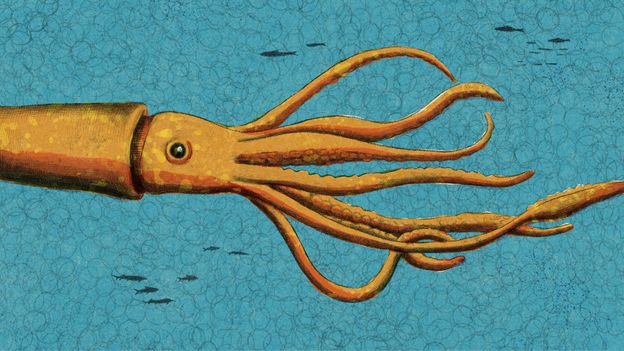
> Widder soon set her sights on a much larger squid. "We actually knew that there were millions of giant squid in the ocean because of the number of giant squid beaks found in sperm whale stomachs." But at the time Widder was doing her experiments, a giant squid had never been caught on film before.
> She designed a new version of her electronic "eye in the sea", which she called the Medusa. Medusa would drift on a 750m-long (2,475ft) line, attached at the surface to a satellite beacon. This way they could leave the eye in the sea for long periods, far from the disturbance of a ship. ([View Highlight](https://read.readwise.io/read/01hynb81fa6t7ntg6x6mvjtwgz))