# The Three Pillars of Zen
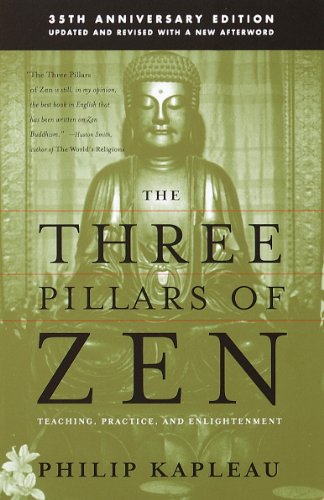
Author:: Roshi P. Kapleau

## AI-Generated Summary
None
## Highlights
> The first of the three essentials of Zen practice is strong faith (daishinkon). This is more than mere belief. The ideogram for kon means “root,” and that for shin, “faith.” Hence the phrase implies a faith that is firmly and deeply rooted, immovable, like an immense tree or a huge boulder. It is a faith, moreover, untainted by belief in the supernatural or the superstitious. Buddhism has often been described as both a rational religion and a religion of wisdom. ([Location 1301](https://readwise.io/to_kindle?action=open&asin=B00H129592&location=1301))
> The second indispensable quality is a feeling of strong doubt (daigidan).42 Not a simple doubt, mind you, but a “doubt-mass”—and this inevitably stems from strong faith. It is a doubt as to why we and the world should appear so imperfect, so full of anxiety, strife, and suffering, when in fact our deep faith tells us exactly the opposite is true. It is a doubt which leaves us no rest. ([Location 1308](https://readwise.io/to_kindle?action=open&asin=B00H129592&location=1308))
> From this feeling of doubt the third essential, strong determination (dai-funshi), naturally arises. It is an overwhelming determination to dispel this doubt with the whole force of our energy and will. Believing with every pore of our being in the truth of the Buddha’s teaching that we are all endowed with the immaculate Bodhi-mind, we resolve to discover and experience the reality of this Mind for ourselves. ([Location 1316](https://readwise.io/to_kindle?action=open&asin=B00H129592&location=1316))