Author: [[Stephen King]]
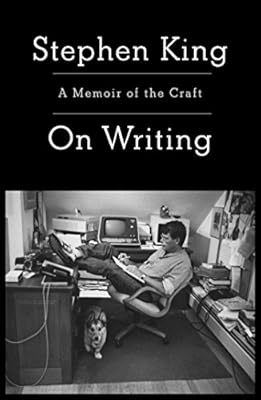
### Highlights first synced by [[Readwise]] [[2020-09-03]]
> "When you write a story, you’re telling yourself the story,” he said. “When you rewrite, your main job is taking out all the things that are not the story.” ([Location 569](https://readwise.io/to_kindle?action=open&asin=B000FC0SIM&location=569))
> Gould said something else that was interesting on the day I turned in my first two pieces: write with the door closed, rewrite with the door open. ([Location 571](https://readwise.io/to_kindle?action=open&asin=B000FC0SIM&location=571))
> Come to it any way but lightly. Let me say it again: you must not come lightly to the blank page. ([Location 1181](https://readwise.io/to_kindle?action=open&asin=B000FC0SIM&location=1181))
> If the moment of quickening is to come, it comes at the level of the paragraph. ([Location 1508](https://readwise.io/to_kindle?action=open&asin=B000FC0SIM&location=1508))
> If you want to be a writer, you must do two things above all others: read a lot and write a lot. There’s no way around these two things that I’m aware of, no shortcut. ([Location 1590](https://readwise.io/to_kindle?action=open&asin=B000FC0SIM&location=1590))
^0506f8
> Being swept away by a combination of great story and great writing—of being flattened, in fact—is part of every writer’s necessary formation. You cannot hope to sweep someone else away by the force of your writing until it has been done to you. ([Location 1612](https://readwise.io/to_kindle?action=open&asin=B000FC0SIM&location=1612))
> The trick is to teach yourself to read in small sips as well as in long swallows. ([Location 1626](https://readwise.io/to_kindle?action=open&asin=B000FC0SIM&location=1626))
> The sort of strenuous reading and writing program I advocate—four to six hours a day, every day—will not seem strenuous if you really enjoy doing these things and have an aptitude for them; in fact, you may be following such a program already. ([Location 1659](https://readwise.io/to_kindle?action=open&asin=B000FC0SIM&location=1659))
> Constant reading will pull you into a place (a mind-set, if you like the phrase) where you can write eagerly and without self-consciousness. ([Location 1663](https://readwise.io/to_kindle?action=open&asin=B000FC0SIM&location=1663))
> The more you read, the less apt you are to make a fool of yourself with your pen or word processor. ([Location 1665](https://readwise.io/to_kindle?action=open&asin=B000FC0SIM&location=1665))
> The space can be humble (probably should be, as I think I have already suggested), and it really needs only one thing: a door which you are willing to shut. The closed door is your way of telling the world and yourself that you mean business; you have made a serious commitment to write and intend to walk the walk as well as talk the talk. ([Location 1725](https://readwise.io/to_kindle?action=open&asin=B000FC0SIM&location=1725))
> But you need the room, you need the door, and you need the determination to shut the door. ([Location 1748](https://readwise.io/to_kindle?action=open&asin=B000FC0SIM&location=1748))
> Description begins in the writer’s imagination, but should finish in the reader’s. ([Location 1981](https://readwise.io/to_kindle?action=open&asin=B000FC0SIM&location=1981))
> Your job during or just after the first draft is to decide what something or somethings yours is about. Your job in the second draft—one of them, anyway—is to make that something even more clear. ([Location 2334](https://readwise.io/to_kindle?action=open&asin=B000FC0SIM&location=2334))
> starting with the questions and thematic concerns is a recipe for bad fiction. Good fiction always begins with story and progresses to theme; it almost never begins with theme and progresses to story. ([Location 2430](https://readwise.io/to_kindle?action=open&asin=B000FC0SIM&location=2430))
> If you’re a beginner, though, let me urge that you take your story through at least two drafts; the one you do with the study door closed and the one you do with it open. With the door shut, downloading what’s in my head directly to the page, I write as fast as I can and still remain comfortable. ([Location 2443](https://readwise.io/to_kindle?action=open&asin=B000FC0SIM&location=2443))
> This first draft—the All-Story Draft—should be written with no help (or interference) from anyone else. ([Location 2449](https://readwise.io/to_kindle?action=open&asin=B000FC0SIM&location=2449))
> If you’ve never done it before, you’ll find reading your book over after a six-week layoff to be a strange, often exhilarating experience. It’s yours, you’ll recognize it as yours, even be able to remember what tune was on the stereo when you wrote certain lines, and yet it will also be like reading the work of someone else, a soul-twin, perhaps. This is the way it should be, the reason you waited. It’s always easier to kill someone else’s darlings than it is to kill your own. ([Location 2487](https://readwise.io/to_kindle?action=open&asin=B000FC0SIM&location=2487))
## Citation
```
[^king]: King, S. (2010). _On writing: A memoir of the craft._ Scribner. [[On Writing|Highlights]].
```